
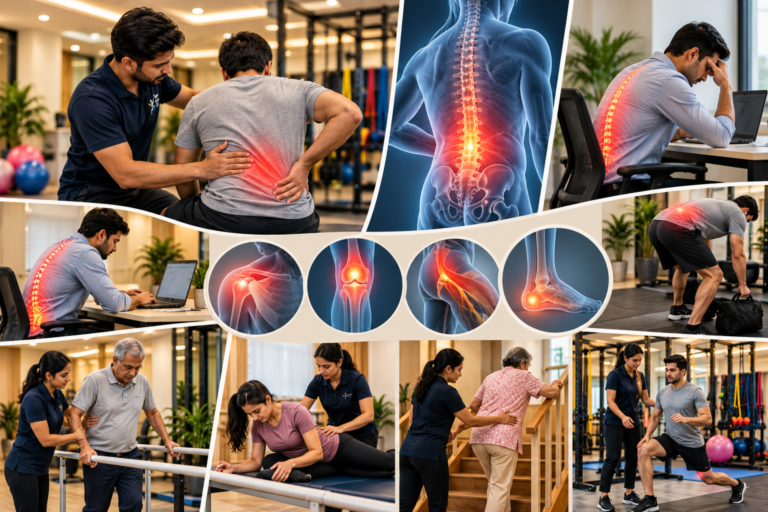
Knee pain is confusing to self-diagnose, and that’s part of why so many people end up in the wrong treatment for months. The pain often shows up at the front of the knee, but the actual cause can be sitting in the hip, the ankle, or the kneecap tracking pattern — which is exactly why a proper assessment matters more here than with most other joints.
One of the most common knee conditions we see is chondromalacia patellae, where the cartilage under the kneecap softens and wears, usually from the kneecap not tracking correctly as the knee bends. It tends to show up as a dull ache at the front of the knee that worsens with stairs, squatting, or sitting for long periods with the knee bent — the classic “theatre sign” where pain builds after sitting through a movie.
Treatment focuses on correcting what’s actually causing the poor tracking, which is often weakness in the hip muscles rather than anything wrong with the knee itself. Strengthening the glutes and outer hip, combined with targeted quadriceps work, usually reduces the pain significantly over four to six weeks, without needing injections or surgery in most cases.


Most knee pain — chondromalacia, mild ligament strains, early-stage osteoarthritis, tendon irritation — responds well to physiotherapy alone. Surgery becomes the more likely path when there’s a complete ligament rupture with instability, a locked knee from a meniscus tear, or imaging that shows significant structural damage.
Even then, physiotherapy usually comes first as a trial, and almost always follows afterward regardless of whether surgery happens. A reasonable rule of thumb: if the knee is swollen, locking, or genuinely unstable when you put weight on it, get it imaged before starting treatment. If it’s an ache that comes and goes with activity, physiotherapy assessment is the right first step.
At The Ordinary Physio, we use TOP MAP to check how the hip, knee, and ankle move together before deciding on a plan — since treating the knee in isolation, without looking at what’s above and below it, is one of the more common reasons knee pain keeps coming back.
Areas we serve near Sector 104, Noida: Sector 100, Sector 101, Sector 102, Sector 105, Sector 107, Sector 108, Sector 82, Sector 93, Hajipur, near Jaypee Hospital, near Sector 81 Metro Station.
Related reading: ACL tear physiotherapy in Noida · Meniscus injury physiotherapy in Noida · What is TOP MAP?
A modern physiotherapy and rehabilitation center in Noida specializing in pain relief, post-surgical rehabilitation, sports injuries, posture correction, neurological rehabilitation, and functional recovery.
Physiotherapy Consultation
Pain Management
Sports Injury Rehabilitation
Orthopedic Rehabilitation
Neurological Rehabilitation
Post-Surgical Rehabilitation
Posture Correction
Dry Needling
Kinesio Taping
Home Physiotherapy
Advanced Rehab Hall
Functional Training Zone
Posture Assessment Lab
Electrotherapy Unit
Manual Therapy Section
Multi-Bed Treatment Area
Strength & Balance Training
Gait Training Programs
Monday – Saturday
9:00 AM – 8:00 PM
Sunday
By Appointment Only
Emergency Consultation Available
© 2026 The Ordinary Physio. All Rights Reserved.
WhatsApp us