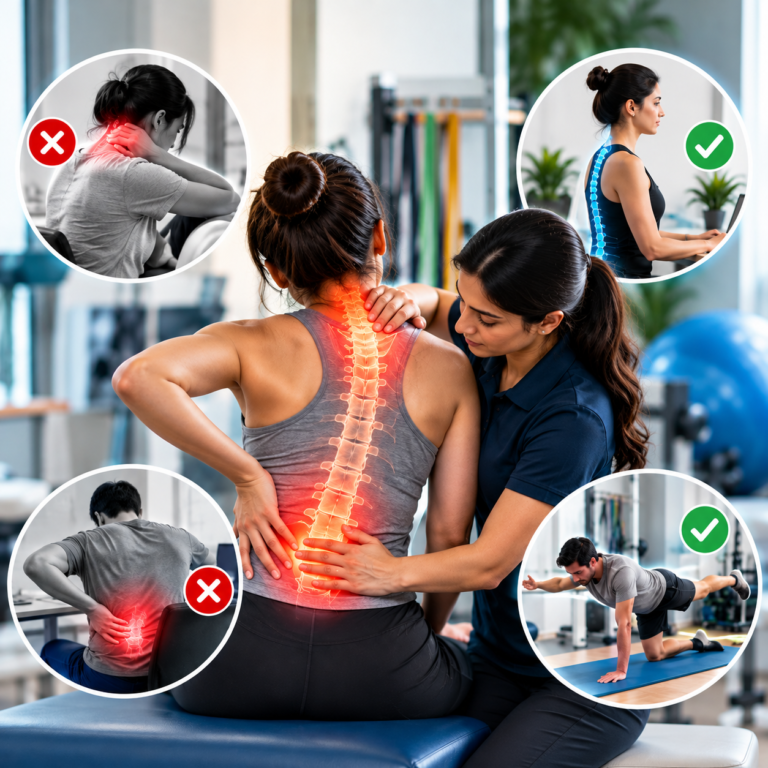
Short answer: it should not be agonising, but it is not always comfortable either. Most people feel some effort, stretch or soreness at some point. What you should never be told is to push through sharp or worsening pain. The useful skill, for you and for us, is telling the two apart.
Exercise is the first source. Strengthening and mobility work is meant to be challenging. A muscle that has not been used properly for months will ache, sometimes the next day. That kind of soreness usually fades within 24 to 48 hours.
Hands-on treatment is the second. Pressure on a tight muscle or a stiff joint can be uncomfortable while we are doing it. It should feel like a “good hurt” that eases as we hold, not something that makes you tense up or hold your breath. If it does, tell us and we change the technique.
Dry needling can produce a brief ache or a muscle twitch, and the muscle may feel sore for a day. Cupping can leave round marks that fade over several days. We explain both beforehand and you can say no to either.
After surgery the picture is different. Early rehabilitation after a knee or hip replacement involves working through stiffness and swelling, and some discomfort is expected. Even then, the aim is controlled, tolerable effort, not the maximum you can stand.

orem ipsum dolor sit amet, consectetur adipiscing elit. Ut elit tellus, luctus nec ullamcorper mattis, pulvinar dapibus leo.
Many clinicians use a zero-to-ten scale, where zero is no pain and ten is the worst you can imagine. For exercise-based rehabilitation a common guide is that discomfort up to about three or four out of ten is acceptable, provided it settles by the next morning and you are not worse the following day. If it climbs higher during the session, lasts beyond a day, or leaves you feeling worse, the dose was too much and we reduce it.
This is a guide, not a law. Some nerve and tendon problems need a more conservative limit, and we set it for you at the first visit.
Tissues adapt to load that is demanding but manageable. Overloading them does not speed things up, it usually sets recovery back and makes people stop coming. Good rehabilitation raises the load gradually, and it keeps pain within a range you can tolerate. That is slower to describe than “push harder” and works better.
Many first-time patients are worried they will be hurt, and past experiences with rough treatment make it worse. We explain what we are about to do before we do it, start gently, and check in often. You can stop any technique at any point, and you can ask for a female physiotherapist. If something is not working, we change the approach instead of persuading you to tolerate it.
Yes. Mild muscle soreness for up to 24 to 48 hours after new or harder exercises is common. If the pain is sharp, getting worse, or still strong after two days, tell us so we can adjust.
Most people feel a brief ache or a muscle twitch when the needle reaches a tight spot. The needles are very fine. Soreness in the area for a day is common and usually settles by itself.
Yes, at any time and for any reason. We would rather stop and change the plan than have you push through something that feels wrong.
Message us on WhatsApp or call +91 87508 81002. The clinic is at Gu-03, Gali Number 6, Sector 104, Noida 201301, on the ground floor with parking.
Related reading: What happens at your first consultation · TOP MAP: how we assess movement · Physiotherapy cost in Noida
Areas we serve from Sector 104: Sector 100, Sector 101, Sector 102, Sector 105, Sector 107, Sector 108, Sector 82, Sector 93, Hajipur.
This article is general information, not a diagnosis. Seek urgent care for chest pain, breathlessness or sudden severe symptoms.
A modern physiotherapy and rehabilitation center in Noida specializing in pain relief, post-surgical rehabilitation, sports injuries, posture correction, neurological rehabilitation, and functional recovery.
Physiotherapy Consultation
Pain Management
Sports Injury Rehabilitation
Orthopedic Rehabilitation
Neurological Rehabilitation
Post-Surgical Rehabilitation
Posture Correction
Dry Needling
Kinesio Taping
Home Physiotherapy
Advanced Rehab Hall
Functional Training Zone
Posture Assessment Lab
Electrotherapy Unit
Manual Therapy Section
Multi-Bed Treatment Area
Strength & Balance Training
Gait Training Programs
Monday – Saturday
9:00 AM – 9:00 PM
Sunday
By Appointment Only
Emergency Consultation Available
© 2026 The Ordinary Physio. All Rights Reserved.
WhatsApp us